Arabic Games for Ages 6–8
Arabic games for ages 6–8: build reading fluency, math confidence and focus with games that feel like play, not homework. Free browser games, no download.
⭐ Featured game: Complete the Word
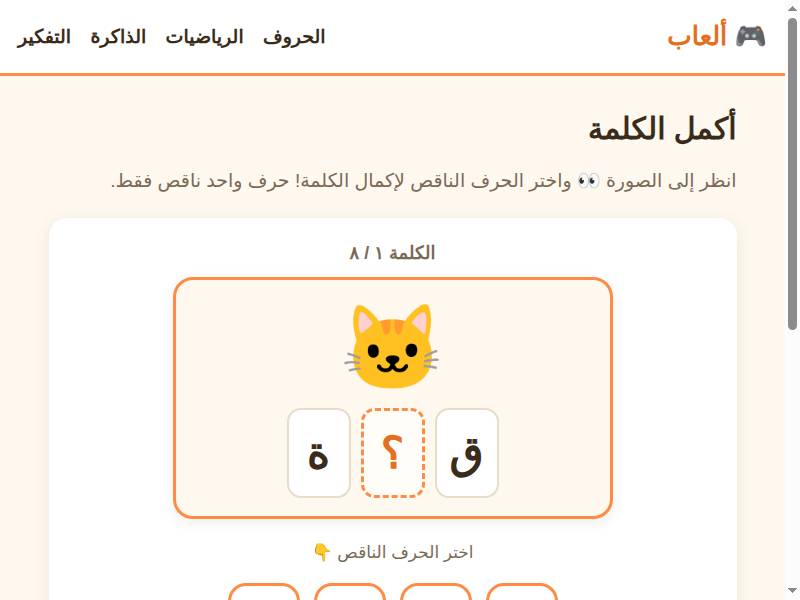
Complete the Word is where reading gets real: your child hears a word, sees it with one letter missing, and must supply the missing sound. It is the bridge from knowing letters to reading words — and the moment Arabic starts to feel like a language, not a subject.
More games to try
The fluency gap at 6–8
Most six- to eight-year-olds ‘know’ the Arabic letters. Far fewer can read fluently — and the difference matters enormously. A child who reads haltingly, sounding out every letter, has no mental energy left to understand what they’re reading. A child who recognizes letters instantly can think about meaning. That gap is fluency, and it is built by speed, not by study.
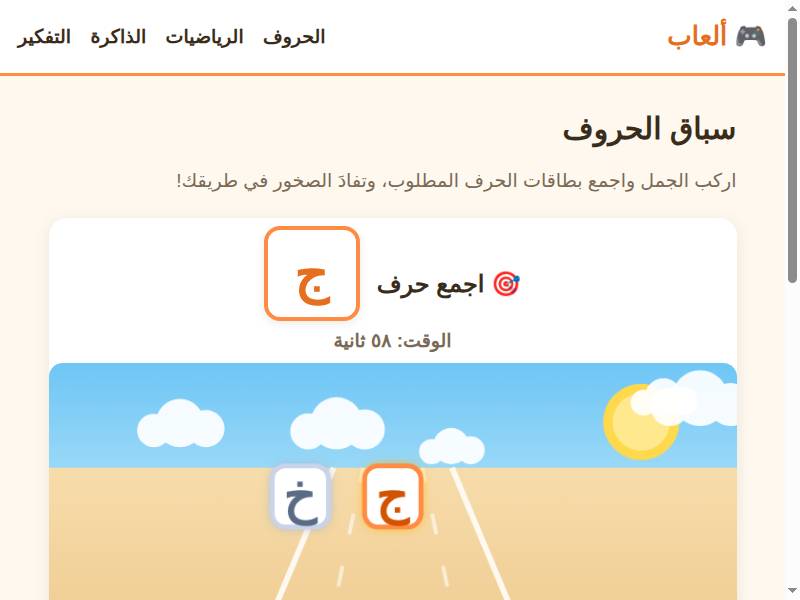
Letter Runner trains exactly that: catch the letter you hear before time runs out. Dozens of rapid recognitions per round, under gentle time pressure, until recognition becomes automatic. It is the difference between knowing the alphabet and being able to read.
Reading: from letters to words
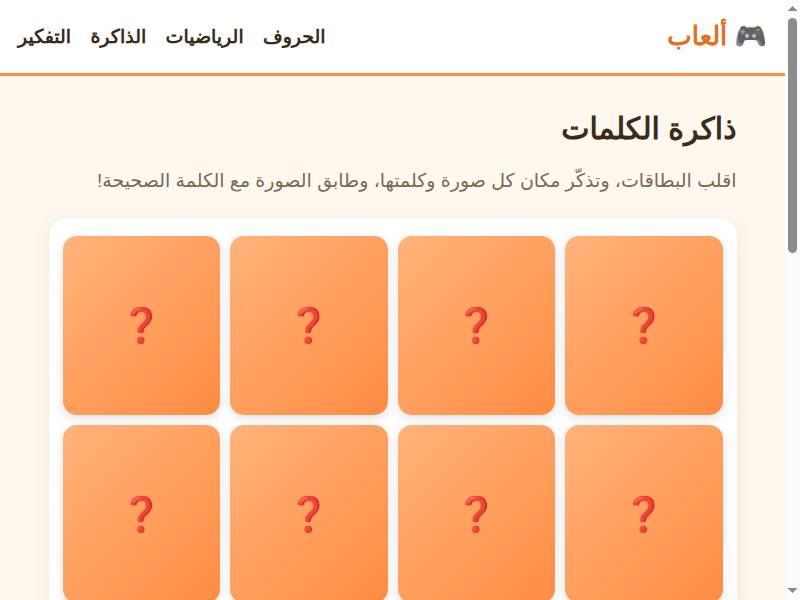
The path from letters to reading has three steps: recognize letters fast, blend sounds into words, and read words in context. Complete the Word handles step two — your child assembles words from their sounds, with the missing letter as the puzzle. Word Memory adds vocabulary: every matched pair is a word with its picture and pronunciation.
Once words click, stories take over. Interactive Stories gives your child real narratives to follow, where vocabulary meets context. A child who reads stories in Arabic is a child who will keep reading — and reading is where fluency becomes permanent.
Math: confidence through play
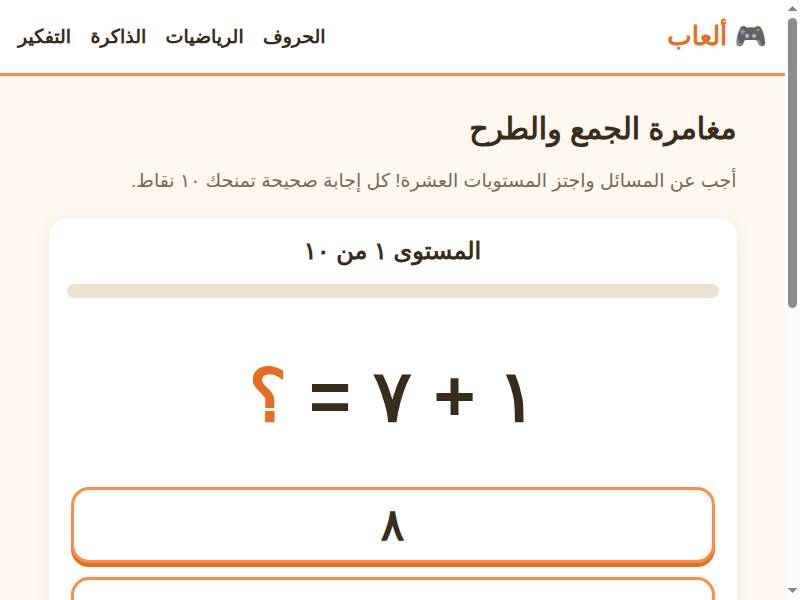
Six to eight is also when math gets real — addition, subtraction, and the first taste of multiplication. Math Quest turns operations into an adventure: solve the problem, advance the quest. Balance Math makes equations physical: balance the seesaw by making both sides equal, and the concept of equality becomes something your child can feel.
All of it happens in Arabic, with Arabic-Indic numerals. Your child is building math confidence and Arabic numeracy in the same session — and because the games are fun, they practice far more problems than any worksheet could extract.
Focus and memory: the hidden curriculum
Every game at this age trains something beneath the surface: working memory, sustained attention, and the ability to persist through difficulty. Word Memory exercises the hold-and-recall cycle that underlies all school learning. The timed games teach focus under mild pressure — the exact skill exams demand.
Parents often notice the change first in homework: a child who plays memory and focus games starts sitting longer, following multi-step instructions better, and giving up less quickly. That transfer is the hidden curriculum of play.
Tips for parents
First, let your child choose the game — autonomy is the engine at this age. Second, watch for the confusion pairs: when your child consistently mixes two letters, that tells you exactly what to practice. Third, keep it to ten or fifteen minutes daily; consistency beats marathons. Fourth, when your child reads a word aloud for the first time, make it a celebration — that moment deserves an audience.
And remember: the goal is not perfection, it is momentum. A child who plays daily, even briefly, will outpace a child who studies in occasional bursts.
Homework and games: how they reinforce each other
Games and homework are not rivals; they are two halves of the same learning. Homework introduces the concept — the new letters, the new words, the new operations. Games provide the repetition that turns that concept into a skill. A child who does both progresses noticeably faster than a child who does either alone.
The trick is the order: homework first, games second. The lesson plants the seed; the game waters it. When your child struggles with a homework problem, don’t drill it — play the matching game for ten minutes and come back. You will often find the problem solves itself, because the game built the fluency the homework needed.
Teachers notice the difference. Children who play regularly arrive at lessons with faster recognition, better recall, and more confidence — which means the lesson itself goes further. Ten minutes of play is the cheapest homework help there is.
FAQ
Q: My 7-year-old knows the letters but reads very slowly. Is that normal?
A: Very common — it’s a fluency gap, not a knowledge gap. Slow reading means recognition isn’t automatic yet. Speed-based games like Letter Runner target exactly this, by forcing dozens of rapid recognitions per round.
Q: How do I know if my child is ready for word games?
A: If they can recognize most letters by sight, they’re ready for Complete the Word. If they still hesitate on several letters, spend a bit more time on letter fluency games first — words built on shaky letters feel like guessing.
Q: Will games replace Arabic school or tutoring?
A: No — they complement it. Games build fluency, vocabulary, and confidence; school and tutoring build grammar and structured literacy. Children who play alongside formal learning progress noticeably faster in both.
Q: My child says the games are too easy / too hard. What do I do?
A: Move up or down the age range. The games scale, and the right difficulty is the one where your child succeeds about three times out of four — challenged, not frustrated, and never bored.
🎮 Free to play, no download needed
Play Complete the Word now — free