Arabic Games for Ages 9–10
Arabic games for ages 9–10: real challenges for kids who outgrew baby games — logic puzzles, spelling, multiplication and story sequencing. Free, no download.
⭐ Featured game: Multiplication Challenge
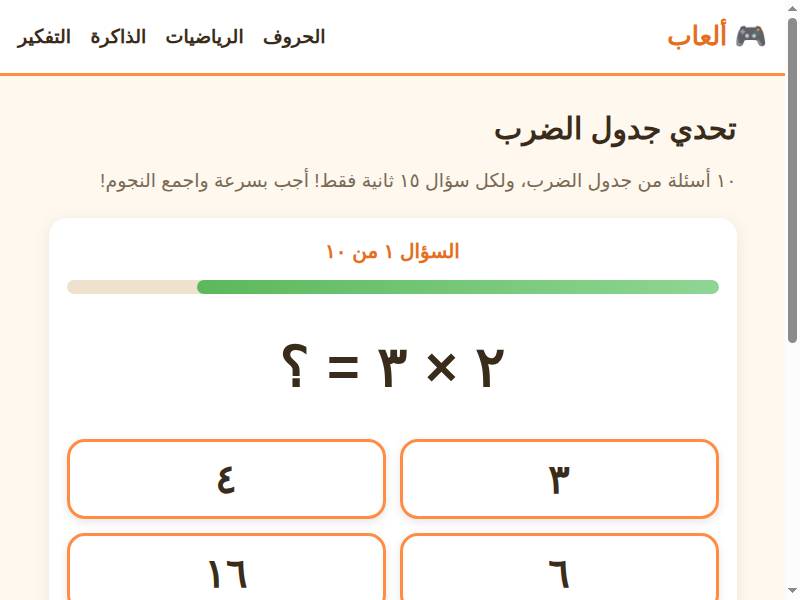
Multiplication Challenge is pure speed math: beat the clock on times tables, in Arabic, with Arabic-Indic numerals. No cartoon hand-holding — just the satisfying tension of a score climbing against the timer. Nine-year-olds find it addictive.
More games to try
Why 9–10 needs a different kind of game
A nine-year-old who is still shaky on Arabic does not need another baby game — they need a game that respects them. The worst thing you can hand an older child is something that feels designed for a five-year-old; they will reject it in seconds, and they will be right. The games for this age are built differently: faster, harder, scored, and genuinely competitive — with themselves, if not with siblings.
The Arabic in these games is real, not simplified: full words, real spelling challenges, genuine reading. Your child is not ‘learning the alphabet’ anymore — they are using Arabic as the medium of a game they actually want to win.
Logic and thinking games
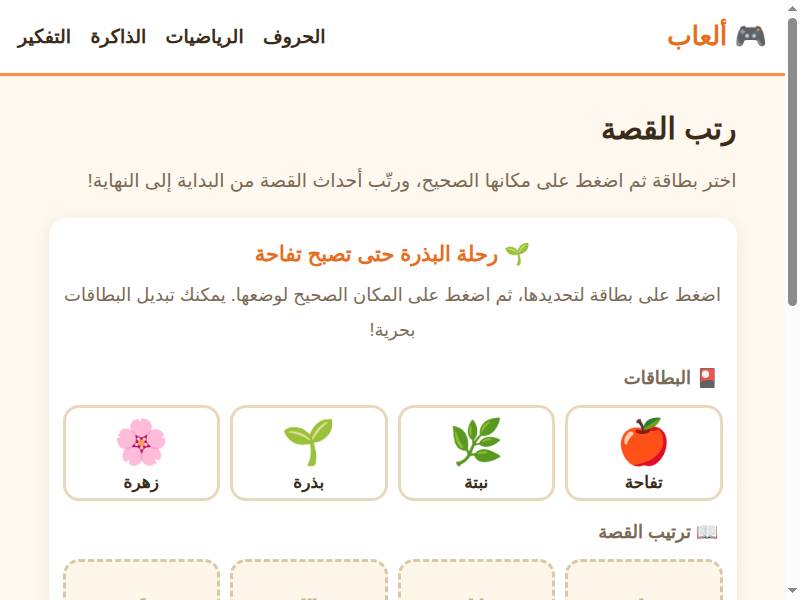
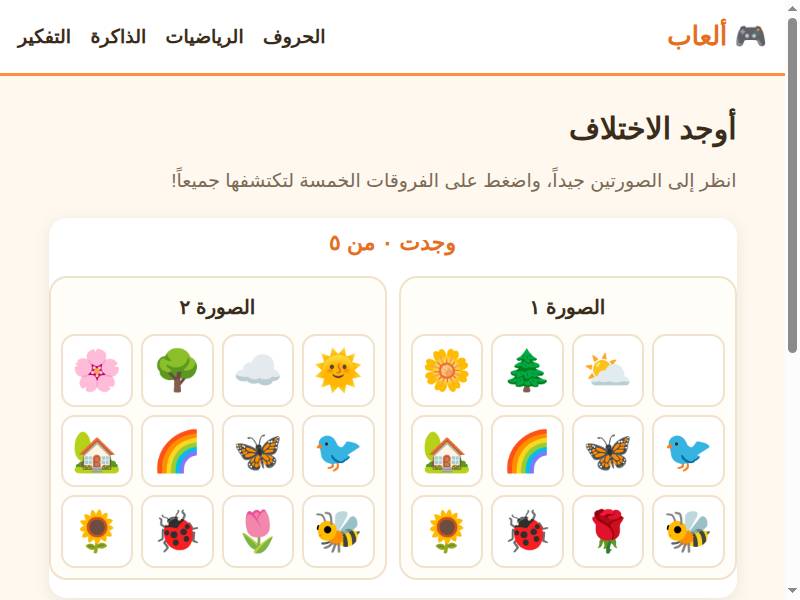
Spot the Difference trains sustained visual attention — finding small changes between two busy pictures is harder than it looks, and it is the same skill that catches errors in schoolwork. Story Order asks your child to sequence a narrative correctly, which exercises comprehension and logical ordering at once. Car Commands introduces sequencing and planning — the foundations of computational thinking — disguised as a driving puzzle.
These games matter because they train thinking in Arabic. Your child is reasoning, sequencing, and problem-solving in the language — which is a far deeper form of fluency than memorizing vocabulary lists.
Spelling and vocabulary at this age
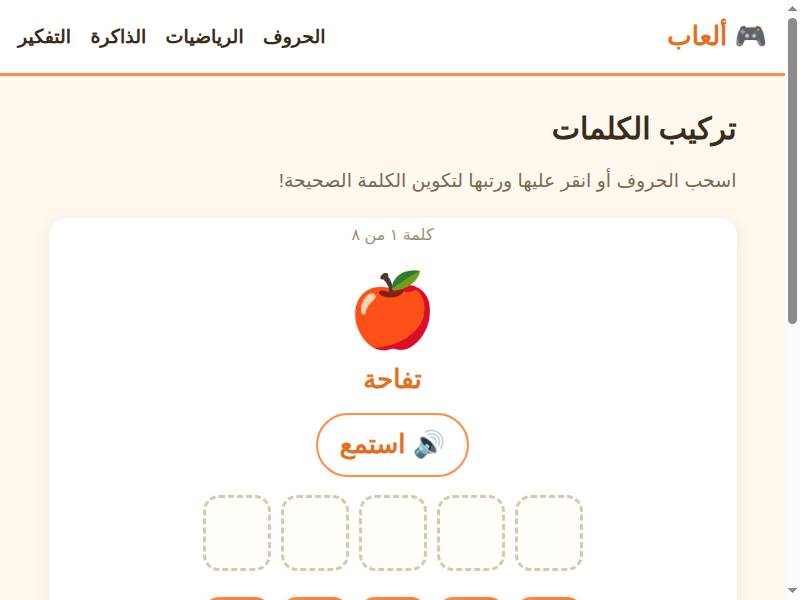
Word Puzzle and Complete the Word are the spelling workhorses for older kids: build words from letters, fill the missing letter, beat the clock. At this age, the goal shifts from recognition to accuracy — spelling a word correctly, not just knowing it.
Interactive Stories adds the reading layer: longer narratives, richer vocabulary, and the connective tissue of real sentences. A child who reads stories in Arabic is building the reading stamina that school demands — in both languages.
Math: multiplication and beyond
Multiplication Challenge covers the times tables with speed pressure — the only way times tables truly become automatic. Balance Math goes deeper: equations as a seesaw, teaching the concept of equality that algebra will later build on. Both use Arabic-Indic numerals, so your child’s math fluency and Arabic numeracy grow together.
If your child already knows the tables in English, the Arabic version comes quickly — the math is already there; only the symbols and the language are new. That transfer is one of the quiet advantages of bilingual math.
Tips for parents
First, don’t frame it as catching up — frame it as a challenge. ‘Can you beat your high score?’ works; ‘You need to practice your Arabic’ doesn’t. Second, let them play in private — older children are acutely self-conscious, and private practice removes the embarrassment. Third, connect the games to real life: Arabic on menus, in videos, in messages from family. Fourth, if your child is genuinely behind on reading, pair the challenge games with a few fluency sessions — confidence first, challenge second.
Sibling play: competition that teaches
Nothing motivates a nine-year-old like beating a sibling. Use it. Set up a daily challenge: who can score higher on Multiplication Challenge, who can finish a Word Puzzle faster, who can spot more differences. Keep it light, keep it friendly, and watch both children practice far harder than either would alone.
Siblings also teach each other. An older child explaining a game to a younger one is doing some of the most powerful learning there is — explaining forces understanding. And the younger child gets a tutor who speaks their language: a brother or sister, not a teacher.
One rule keeps it healthy: compete on effort and improvement, not on who is ‘better at Arabic.’ Celebrate personal bests, not victories over each other. The goal is two children who love the language, not one winner and one loser.
FAQ
Q: My 10-year-old can’t read Arabic yet. Is it too late?
A: Not even close. Older children catch up fast because they bring stronger logic, better memory, and real motivation. Start with fluency games in private, then move to the challenge games here. Weeks, not years, is the realistic timeline.
Q: Won’t my child find these games babyish?
A: These specific games are chosen for older kids: scored, timed, and genuinely hard. If your child finds one too easy, move up — the collection scales, and the right difficulty is the one where they succeed about three times out of four.
Q: Should a 9-year-old still play letter games?
A: Only if letter fluency is still shaky. If your child reads words comfortably, skip letter games entirely — they’re a means, not an end. The challenge games here are the right level.
Q: How does this help with school Arabic?
A: School Arabic tests reading, spelling, and comprehension — exactly what these games train. The difference is motivation: children practice far more in games than in homework, and practice is what converts knowledge into skill.
🎮 Free to play, no download needed
Play Multiplication Challenge now — free