Arabic Homeschool Games for Kids
Arabic homeschool games: a free, no-prep companion for your homeschool curriculum — letters, words, math and logic, organized by skill. No download, no signup.
⭐ Featured game: Math Quest
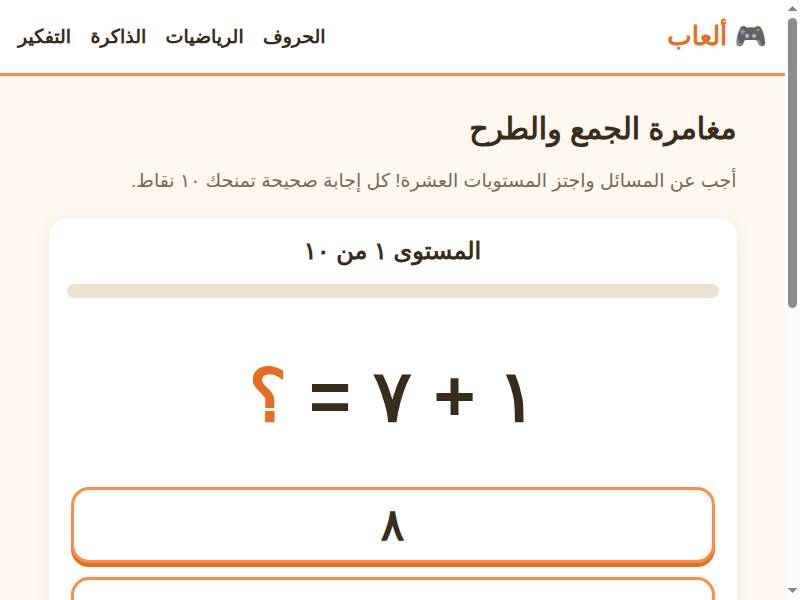
Math Quest is the homeschool workhorse: addition and subtraction adventures that feel like a game and function like a lesson. Assign a session, and your child gets targeted math practice in Arabic — with zero prep from you.
More games to try
The homeschool problem games solve
Homeschooling Arabic has a specific pain: you can teach the lesson, but practice is hard to make stick. Worksheets get groans, flashcards get eye-rolls, and you are left nagging — which helps nobody. Games solve the practice problem by making repetition voluntary. A child who will not do twenty worksheet problems will happily play twenty rounds of a game that contains the same twenty problems.
The games also solve the prep problem. No printing, no laminating, no lesson planning: open the browser, pick the game that matches today’s lesson, play ten minutes. That is the whole prep.
A simple weekly rhythm
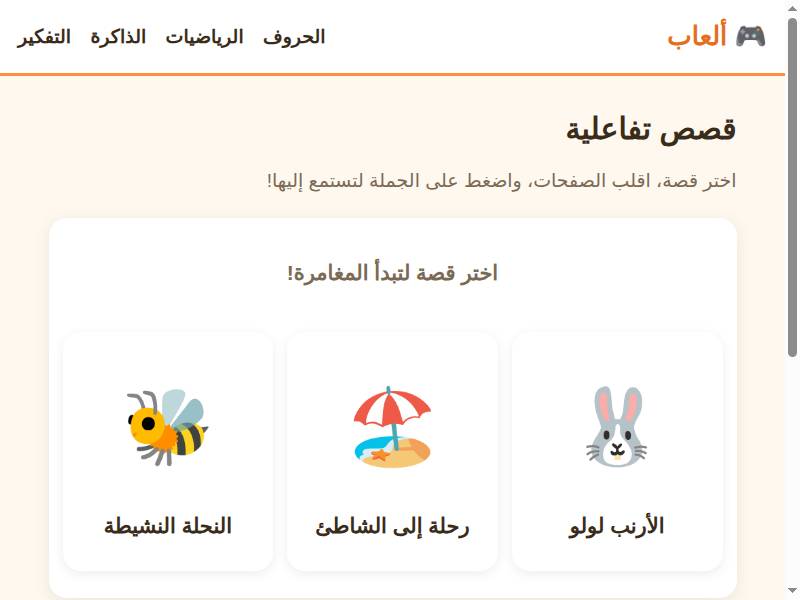
Here is a rhythm that works for many families: Monday and Wednesday for letters and words — tracing, matching, spelling. Tuesday and Thursday for math — counting, quests, balance. Friday for stories and free choice — whatever your child wants. Ten to fifteen minutes per session, always at the same time of day, so it becomes a habit rather than a negotiation.
The games are organized by skill on the site, so matching them to your curriculum is straightforward: letters week, use the letter games; numbers week, use the math games; vocabulary week, use the word games.
Letters and words: the language block
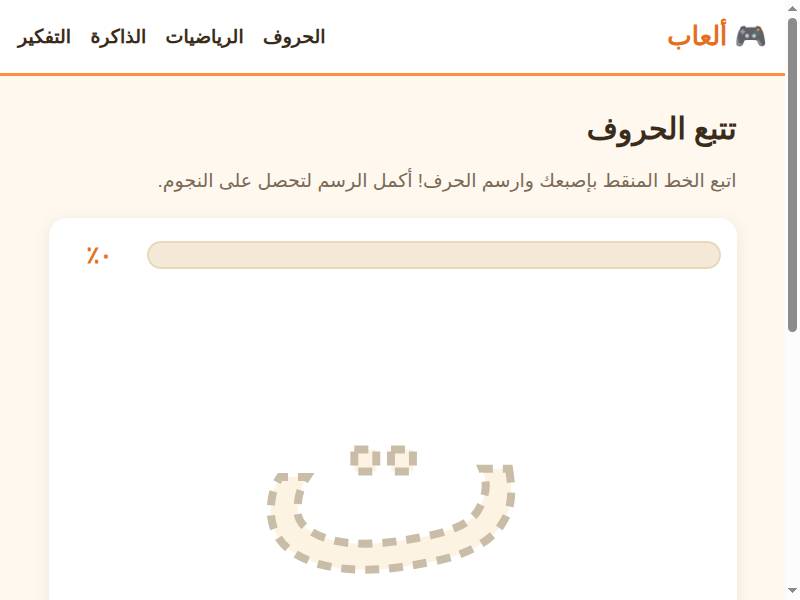
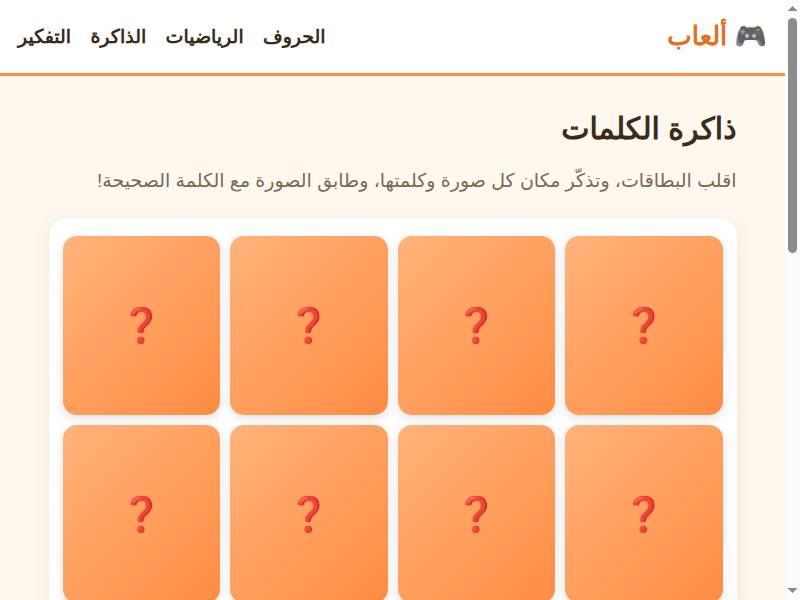
For the language block, sequence matters: listening games first (train the ear), then tracing (train the hand), then matching and spelling (train recognition and production). Letter Tracing teaches stroke order; Letter Match drills lookalike discrimination; Complete the Word bridges to real reading.
Keep a simple log: which letters your child confuses, which words they now know. The games make progress visible — a child who could not find ب last month and now finds it instantly has learned something real, and the log proves it.
Math and logic: the thinking block
For the math block, follow your child’s level, not their age. Counting for one-to-one correspondence, Math Quest for operations, Balance Math for the concept of equality, Multiplication Challenge for times tables. The logic games — mazes, sequencing, spot-the-difference — train the thinking skills that underpin all subjects.
All of it happens in Arabic, which means your math block doubles as Arabic immersion. That double duty is one of the quiet advantages of homeschooling with games: every subject is also language practice.
Assessment without exams
Homeschoolers still need to know: is this working? The games give you observable evidence without a single test. Can your child find letters faster than last month? Can they read words they couldn’t before? Can they solve problems they used to guess at? Those observations are assessment — and they are more honest than any quiz, because they measure skill in action.
If a skill stalls, don’t push harder — drop down a level. The games scale, and a week back at an easier level usually unlocks the next one.
What to do when progress stalls
Every homeschooler hits it: a skill that was climbing suddenly flatlines. Your child knew the letters last month and now seems to have forgotten them. The vocabulary stopped growing. The math got stuck. First, breathe — plateaus are normal, and they are usually followed by a jump, not a decline.
Second, diagnose gently. Is it a skill gap (the letters genuinely aren’t solid), a motivation gap (the games got boring), or a life gap (a busy week, a growth spurt, a bad mood)? Each has a different fix: skill gaps need an easier level, motivation gaps need a new game, life gaps need patience.
Third, change one variable at a time. Switch the game, change the time of day, or play together instead of solo — but don’t change everything at once, or you’ll never know what worked. And remember: a week off is not failure. Sometimes the brain consolidates during the break, and your child returns stronger.
FAQ
Q: Can games really be part of a homeschool curriculum?
A: As the practice layer, yes. You teach the concept; the games provide the repetition that turns concepts into skills. They don’t replace your teaching — they make your teaching stick.
Q: How do I choose which games match my lesson?
A: Match by skill: letters week → letter games; numbers week → math games; vocabulary week → word games. Every game shows its skill and age range on its page, so planning takes seconds.
Q: Do I need to sit with my child during game time?
A: For the first few sessions, yes — to establish the routine and the goal. After that, older children can play independently while you observe progress. Younger children benefit from you nearby.
Q: What if my child just wants to play the same game every day?
A: Let them — for a while. Repetition is how skills form. When the game gets too easy, gently introduce the next one in the sequence. Mastery of one game is better than shallow play across ten.
🎮 Free to play, no download needed
Play Math Quest now — free