Arabic Letter Games for Kids
Arabic letter games that build real fluency: match pairs, spot lookalikes, beat the clock. Free browser games, no download. For kids who know the alphabet and want mastery.
⭐ Featured game: Letter Match
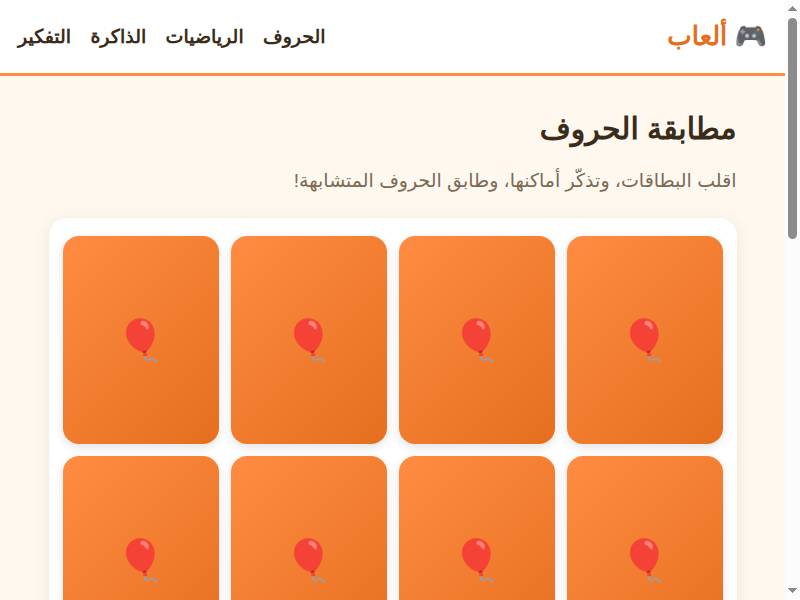
Letter Match takes the classic memory-card game and fills it with Arabic letters: flip two cards, and if the letters match, you hear them pronounced. Deceptively simple — and brutally effective at burning lookalike letters into memory.
More games to try
Knowing letters vs. mastering them
There’s a gap most parents discover too late: a child can recite the alphabet and still read haltingly, because reciting is memory and reading is recognition. Mastery means seeing ث and knowing it instantly — not after sounding out ‘that’s the one with three dots.’
The lookalike families (ب ت ث ن ي, ج ح خ, س ش, ص ض, ط ظ, ع غ) cause 90% of early reading stumbles. Letter games attack exactly this: rapid-fire matching, spotting, and pairing that forces the brain to notice the tiny differences — dot count, dot position, curve shape — until distinguishing them becomes automatic.
How to play
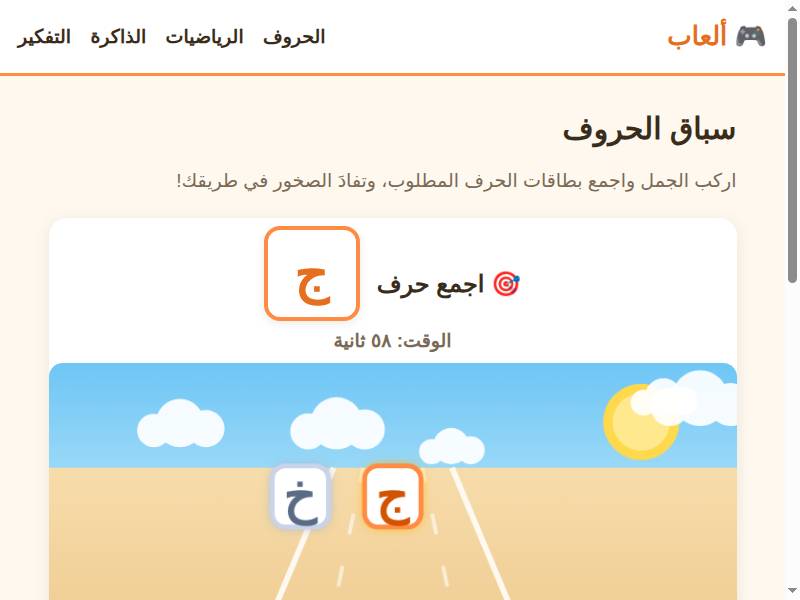
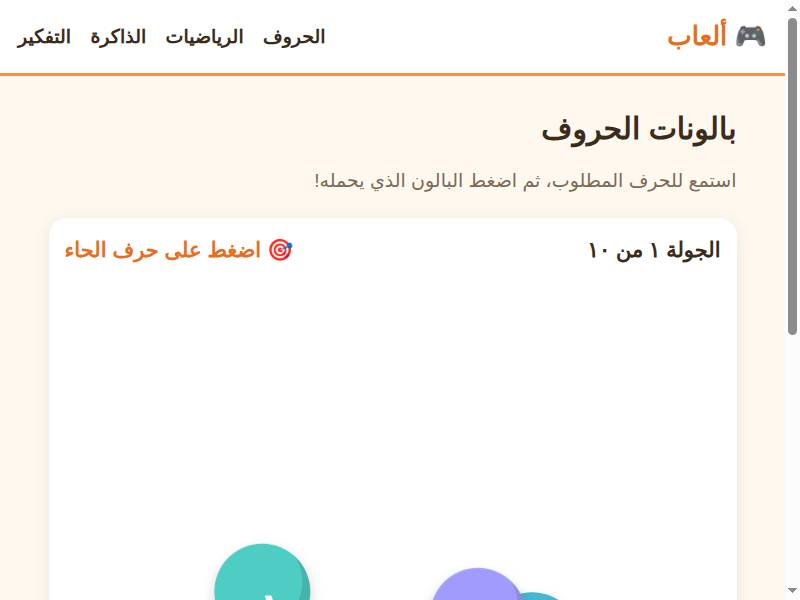
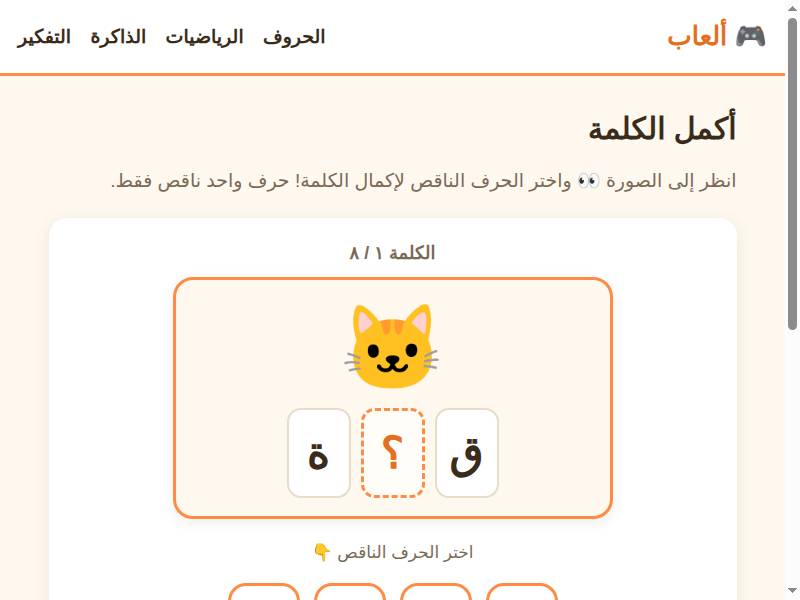
Pick a game and open it in any browser — no download, no account. In Letter Match, tap two cards; matching letters stay face-up and get pronounced. In Letter Runner, sprint after the letter you hear. In Complete the Word, fill the missing letter to finish a word. Rounds are short, difficulty climbs gently, and every game pronounces letters aloud, so the sound-shape link strengthens with every round.
The skills these games build
Three specific reading muscles: visual discrimination (telling similar letters apart at speed), sound-symbol fluency (hearing ب and seeing ب as one thing, not two), and working memory (holding a letter in mind while scanning for its match). These are the exact sub-skills reading researchers measure — and the exact ones worksheets train poorly, because worksheets can’t do speed, sound, and instant feedback at once.
What age is this for?
Ages 4 to 8. Four- and five-year-olds who know the basic letters use these games to lock them in; six- to eight-year-olds use them to build the speed that fluent reading demands. If your child reads Arabic slowly or guesses at words, weak letter fluency is the usual culprit — and it’s very fixable at this age.
Tips for parents
Watch for the confusion pairs: when your child consistently mixes two letters, that’s gold — it tells you exactly what to practice. Play the relevant game together and make a silly distinction (‘ث has THREE dots — three!’). Don’t drill the whole alphabet; drill the confusions. And when lookalikes stop being a problem, move to words: our spelling and word games are the natural next step.
FAQ
Q: What’s the difference between alphabet games and letter games?
A: Alphabet games introduce the 28 letters to beginners. Letter games are for kids who broadly know the letters and need fluency — faster recognition, lookalike discrimination, and connecting letters to words. If your child ‘knows’ the letters but reads slowly, you want letter games.
Q: My child constantly mixes up ب ت ث. Is something wrong?
A: Nothing is wrong — those three differ only in dots, and every Arabic-learning child confuses them. It’s the single most common struggle. Targeted matching games fix it in weeks because they force hundreds of tiny discriminations that worksheets can’t.
Q: Do the games teach the different letter forms (start/middle/end of word)?
A: Yes — letters appear in their connected forms inside words in our spelling and word games, so children absorb the shape changes in context, the way native learners do, rather than memorizing a chart of isolated forms.
Q: Why not just use flashcards?
A: Flashcards are slow, silent, and boring — three strikes. Games are fast (dozens of recognitions per minute), spoken (every letter pronounced), and self-motivating (kids choose to repeat). For building fluency, there’s no contest.
🎮 Free to play, no download needed
Play Letter Match now — free