Arabic Memory Games for Kids
Arabic memory games for kids: match Arabic words to pictures, train focus and grow vocabulary through play. Free, no download, no signup. Ages 3–9.
⭐ Featured game: Word Memory
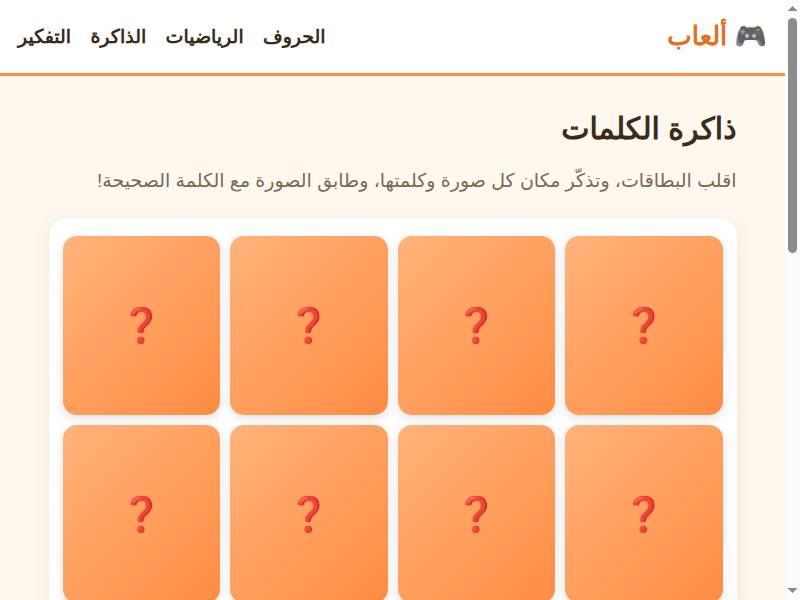
Word Memory is the classic flip-and-match game, rebuilt for Arabic: match each word to its picture, and every match pronounces the word aloud. Five minutes a day builds both vocabulary and the working memory that school success runs on.
More games to try
Two skills in one game
Every memory game trains two things at once. The obvious one is memory itself — holding card positions in mind, updating them as cards flip: the exact definition of working memory. Less obvious is vocabulary: in Word Memory, each pair is an Arabic word and its picture, pronounced aloud on every match.
A child who plays for a month has heard and seen dozens of everyday words tens of times each — the kind of effortless repetition that builds a mental dictionary. Teachers call this ‘incidental learning’: the child came to play and left with words.
How to play
Open any game in the browser — no download, no account, works on phones and tablets. In Word Memory, tap two cards; matching word-picture pairs stay open and get pronounced. Start with fewer cards for little ones (the game scales), and let the difficulty grow with your child. Short sessions work best: the brain consolidates memory between sessions, not during marathons.
Why memory training matters
Working memory — the ability to hold and manipulate information in mind — is one of the strongest predictors of school achievement, and it’s most trainable in early childhood. Memory games are one of the few genuinely effective ways to exercise it: they require exactly the hold-update-recall cycle the skill is made of. Add the Arabic vocabulary layer, and you’re training the brain in the language you want to keep.
What age is this for?
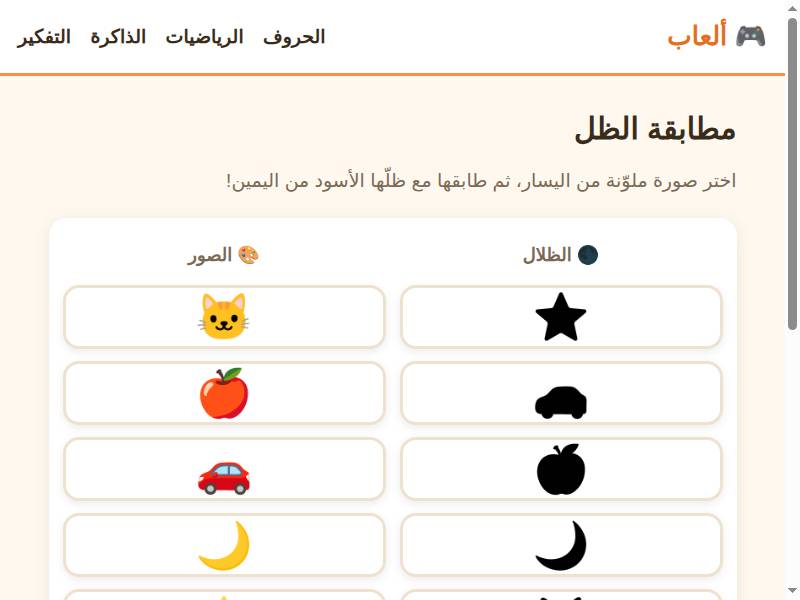
Ages 3 to 9, with the games scaling to fit. Three- to five-year-olds do best with picture matching (Color Match, Shadow Match) — pure visual memory, no reading needed. Five- to nine-year-olds are ready for Word Memory, where words enter the picture, and Spot the Difference, which trains sustained attention. Siblings of different ages can genuinely play side by side.
Tips for parents
First, let your child lose — struggling to remember is the workout; rescuing them skips it. Second, name the words aloud together when they match (‘تفاحة!’) — saying the Arabic word doubles the vocabulary gain. Third, play the same game over several days rather than hopping between games; memory improves with familiar material. Fourth, if your child gets frustrated, drop the difficulty, not the game — confidence is the engine.
FAQ
Q: Do memory games actually improve memory, or is that just marketing?
A: The honest answer: they train the specific skill they exercise — holding visual information in mind — and that skill transfers best to similar tasks, like remembering where things are or following multi-step instructions. Combined here with Arabic vocabulary, the payoff is concrete: more words, better focus.
Q: My child can’t sit still for two minutes. Will this work?
A: Start with the fastest games (Shadow Match rounds take about a minute) and let movement happen — kids can play standing up, on a tablet, wherever. Attention is built gradually; demanding stillness first is backwards.
Q: What Arabic words will my child actually learn?
A: Everyday concrete nouns — animals, foods, objects — the words children need first. Each is paired with a picture and pronounced aloud on every match, so meaning, sound, and spelling arrive together.
Q: Can my 4-year-old and 8-year-old play together?
A: Yes — that’s the beauty of it. The little one plays for the pictures, the older one for the words and the challenge. Take turns, and the older child explaining words to the younger one is itself powerful learning.
🎮 Free to play, no download needed
Play Word Memory now — free