How to Teach Your Child Arabic
How to teach your child Arabic when you’re busy and your own Arabic is rusty: the right order, 10 minutes a day, and free games that do the teaching. A guide for diaspora parents.
⭐ Featured game: Interactive Stories
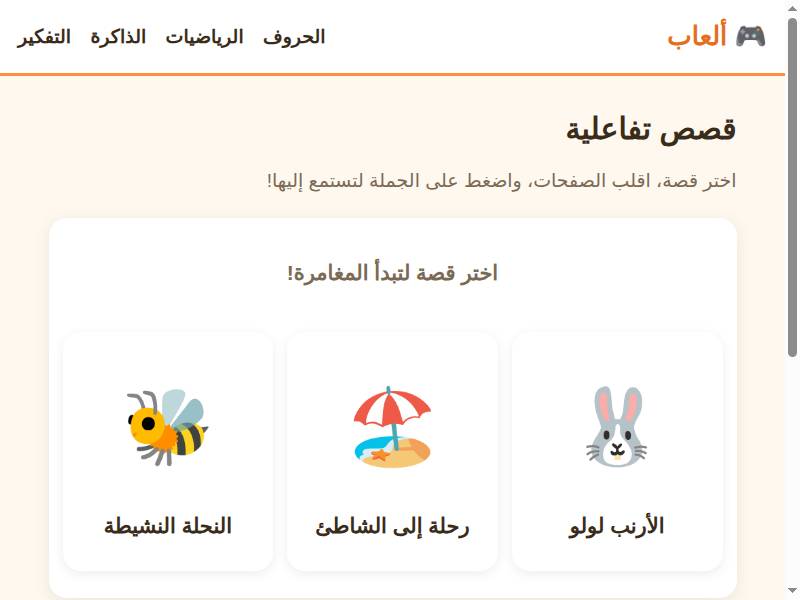
Interactive Stories is where it all comes together: read-along tales in Arabic that build vocabulary in context. When your child is ready for words and sentences — not just letters — stories are the bridge.
More games to try
The order that actually works
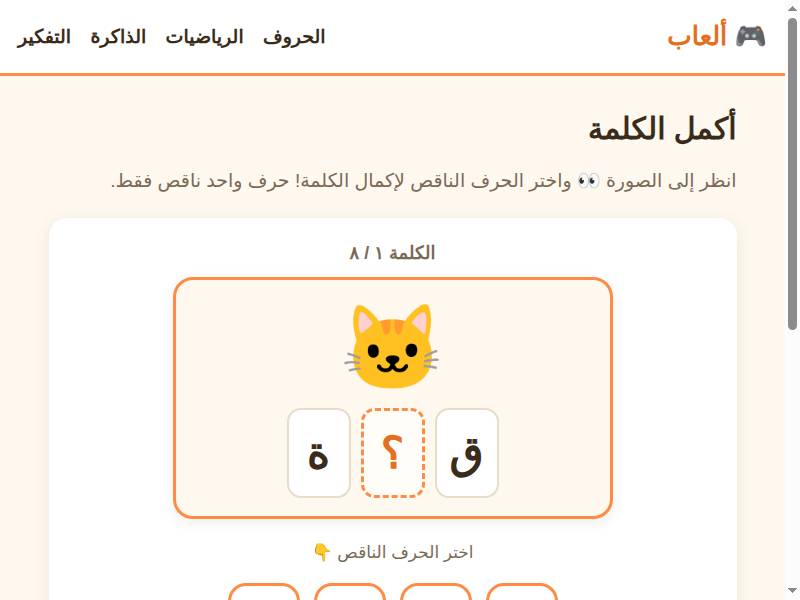
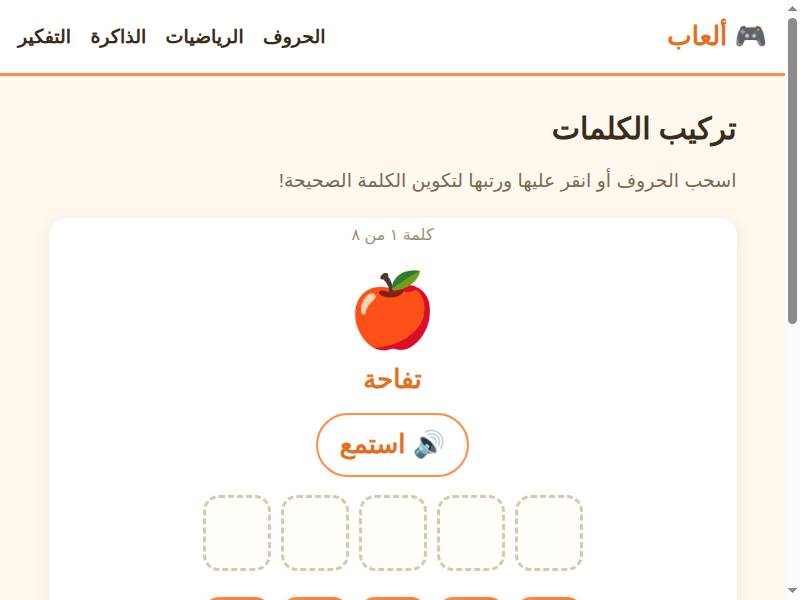
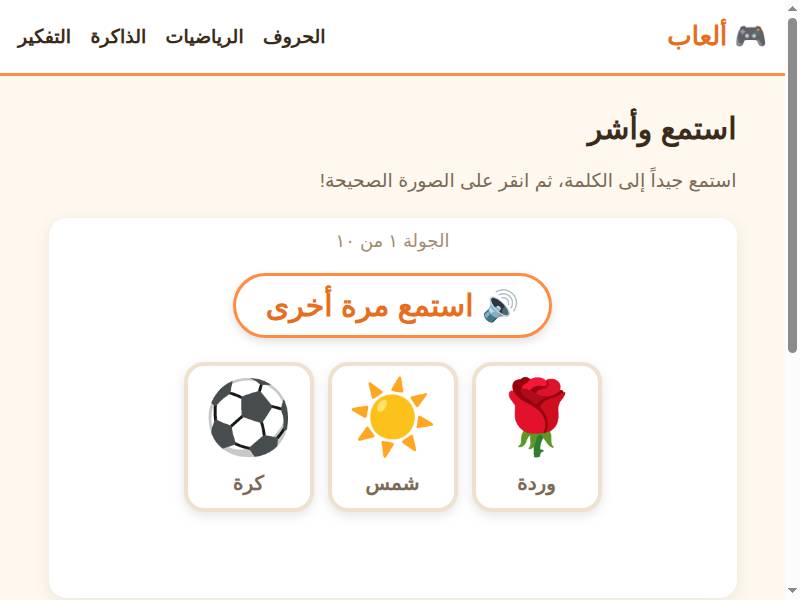
Parents usually start with the alphabet chart. That’s step two, not step one. The order that works: 1) Listening — can your child distinguish Arabic sounds? Games like Listen and Point train the ear with zero reading. 2) Letters — sound-to-shape matching through balloon and runner games. 3) Words — spelling and memory games that attach meaning to letter strings. 4) Stories — read-along tales where vocabulary meets context.
Each step takes weeks, not days, and each makes the next one dramatically easier. Skip a step and you’ll feel it; follow the order and progress feels almost automatic.
The ten-minute method
Forget the weekend Arabic school model (two hours of groaning, forgotten by Wednesday). What works is ten focused minutes daily — the same principle behind every successful habit. One game session. Same time each day, ideally.
The games are built for this rhythm: short rounds, instant feedback, clear stopping points. Consistency beats intensity so completely that it’s not close: ten minutes daily outperforms two hours weekly by a mile, because young brains consolidate between sessions.
When your own Arabic is rusty
This is the secret fear of half our parents, so let’s say it plainly: you don’t need to be fluent to raise a bilingual child. You need to be the facilitator, not the teacher. The games provide the native-quality audio and the structured practice; you provide the routine, the encouragement, and the ten minutes of presence.
Many parents report their own Arabic improving alongside their child’s — which, by the way, your child notices, and it teaches something no lesson can: that learning is lifelong.
What about dialect vs. standard Arabic?
Speak your dialect at home — always. It’s your child’s heritage and their connection to family. Use Modern Standard Arabic for reading and the games, because that’s the written language and what schools teach. Children handle this split effortlessly; it’s the same pattern as speaking one way with friends and reading books in standard English. Don’t let the dialect question paralyze you — any Arabic is infinitely better than none.
Keeping it going (the real challenge)
Starting is easy; month three is where families quit. Three things prevent that: first, tie Arabic to something your child already loves (games, stories, video calls with grandparents — not ‘study time’). Second, track streaks, not hours — a calendar with X’s is weirdly motivating for kids. Third, lower the bar on bad days: one round of any game counts. A maintained streak of tiny sessions beats a heroic effort that collapses.
FAQ
Q: My Arabic is really bad. Can I still teach my child?
A: Yes — by being the coach, not the teacher. Set up the ten minutes, sit with them, celebrate wins. The games supply correct pronunciation and structured practice; you supply consistency and love. That’s the larger half of the job.
Q: How much time per day does it realistically take?
A: Ten to fifteen minutes of focused play. Not an hour, not a curriculum — one game session. The research on habit formation and the parents in our community converge on the same number: small daily beats big weekly, every time.
Q: Should we focus on our dialect or Modern Standard Arabic?
A: Both, in their lanes: dialect for speaking at home and with family, standard for reading, writing, and the games. Kids navigate this split naturally. The enemy isn’t the ‘wrong’ Arabic — it’s no Arabic.
Q: My child refuses to speak Arabic and answers in English. What now?
A: Don’t force output — it’s the fastest way to build resistance. Keep input rich (games, stories, Arabic media in the background) and celebrate any Arabic attempt extravagantly. Output follows input, on the child’s timeline, not yours. Pressure delays; patience accelerates.
🎮 Free to play, no download needed
Play Interactive Stories now — free